Nodos 2019 Estar de paso
Opening | 28.03.2019, 7.00 p.m.
Exhibition dates | 29.03.2019 - 25.05.2019
Venue | xE – Exhibition room of the Academy of Fine Arts Vienna, Eschenbachgasse 11, Corner Getreidemarkt, 1010 Vienna
Curators: Véronique Boilard, Andrea Haas, Nina Höchtl, Julia Wieger
Participants: Felicity Allen; Anti*Colonial Fantasies – Imayna Caceres, Sunanda Mesquita, Sophie Utikal; Chantal DuPont; ff. Feministisches Fundbüro; Martha Fleming und Lyne Lapointe; Vera Frenkel; Anne Golden; Althea Greenan; Minna Henriksson; Belinda Kazeem-Kamiński; Annette Krauss and the shifting team at the Casco Art Institute; lamathilde; Tanya Mars; Diane Poitras; Anne-Marie Proulx; Martha Rosler; Ego Ahaiwe Sowinski; Sekretariat für Geister, Archivpolitiken und Lücken; Vidéographe; Joyce Wieland; Aida Wilde
Opening hours: Tue–Fri, 11.00 a.m. – 6.00 p.m., Sat: 11.00 a.m. – 3.00 p.m., closed on Sun, Mon and holidays, free access
Ego Ahaiwe Sowinski/Aida Wilde, poster inspired by placards of the Women’s Art Library, Goldsmiths, University of London, installation view, Empowered PrintWorks, 2015, photo: Will Cenci
Like the universe, the realm of cultural production consists mostly of dark energy and matter.1 These invisible masses and movements form from spontaneous, amateurish, autonomous, activist, self-organized, collective practices that play an important part for feminist cultural work. This is also a matter of the unpaid or underpaid labor of those who deliberately shun visibility or have no choice but to remain invisible. It is the invisible dark matter that keeps the cultural sector going!
DARK ENERGY. Feminist Organizing, Working Collectively explores feminist forms of organization and knowledge production in the cultural sector. It gives center stage to the visual, material and performative characteristics of feminist collaborative practices. It asks how these forms of organization and production are influenced by their general economic setup and what begins to sway politically in this context. Which forms of creative dark matter and knowledge can be practiced, produced, and disseminated when, where, and how?
The exhibition brings together a diverse range of efforts that tackle these questions in different contexts and times. Through the work of the participating artists, archivists, designers, and activists the exhibition provides insights from feminist, queer, decolonizing perspectives into the forces that collide with(in) art institutions and organizations.
1 Gregory Sholette, Dark Matter. Art and Politics in the Age of Enterprise Culture, London: Pluto Press 2011.
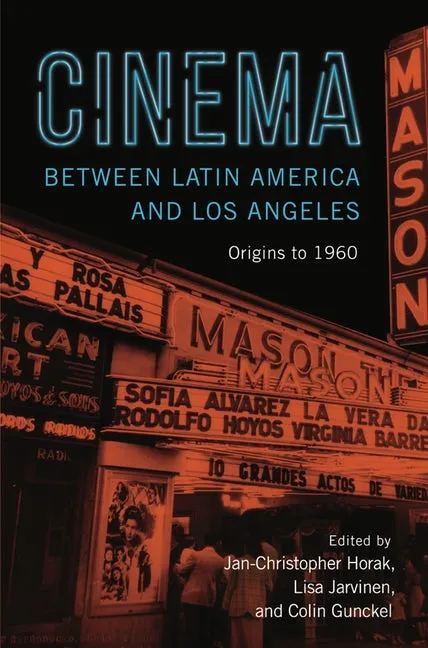
Cinema betwen Latin America and Los Angeles. Origins to 1960
Edited by Colin Gunckel, Jan-Christopher Horak, Lisa Jarvinen
Historically, Los Angeles and its exhibition market have been central to the international success of Latin American cinema. Not only was Los Angeles a site crucial for exhibition of these films, but it became the most important hub in the western hemisphere for the distribution of Spanish language films made for Latin American audiences. Cinema between Latin America and Los Angeles builds upon this foundational insight to both examine the considerable, ongoing role that Los Angeles played in the history of Spanish-language cinema and to explore the implications of this transnational dynamic for the study and analysis of Latin American cinema before 1960. The volume editors aim to flesh out the gaps between Hollywood and Latin America, American imperialism and Latin American nationalism in order to produce a more nuanced view of transnational cultural relations in the western hemisphere.
Contributions by Jacqueline Avila, Alstair Tremps, Viviana García Besné, Desirée J. Garcia, Nina Hoechtl