Exhibición: DARK ENERGY. Feminist Organizing, Working Collectively
Inauguración | 28.03.2019, 19.00 hrs
Exhibición | 29.03.2019 - 25.05.2019
Lugar | xE – espacio de la exhibición de la Academy of Fine Arts Vienna, Eschenbachgasse 11, esquina Getreidemarkt, 1010 Viena
Curadores: Véronique Boilard, Andrea Haas, Nina Höchtl, Julia Wieger
Participantes: Felicity Allen; Anti*Colonial Fantasies – Imayna Caceres, Sunanda Mesquita, Sophie Utikal; Chantal DuPont; ff. Feministisches Fundbüro; Martha Fleming und Lyne Lapointe; Vera Frenkel; Anne Golden; Althea Greenan; Minna Henriksson; Belinda Kazeem-Kamiński; Annette Krauss and the shifting team at the Casco Art Institute; lamathilde; Tanya Mars; Diane Poitras; Anne-Marie Proulx; Martha Rosler; Ego Ahaiwe Sowinski; Sekretariat für Geister, Archivpolitiken und Lücken; Vidéographe; Joyce Wieland; Aida Wild
Ego Ahaiwe Sowinski/Aida Wilde, carteles inspirados en los carteles de la Women’s Art Library, Goldsmiths, University of London, Empowered PrintWorks, 2015, foto: Will Cenci
Como el universo, el corazón de la producción cultural consiste en materia y energía oscuras.1 Estas masas y movimientos invisibles se forman a partir de prácticas espontáneas, amateurs, autónomas, activistas, autogestionadas y coleectivas que juegan un papel fundamental en el trabajo cultural feminista. Un trabajo mal pagado o no retribuido que evita deliberadamente la visibilidad o no tiene eleccion de permanecer invisible. ¡Es la materia oscura e invisible que mantiene el sector cultural funcionando!
DARK ENERGY. Feminist Organizing, Working Collectively explora formas de organización feministas y de producción de conocimiento en el sector cultural. Poniendo en el centro las prácticas colaborativas feministas materiales y performativas, a través del trabajo de artistas, archiveras, diseñadoras y activistas, inscritas desde perspectivas feministas, queer y descolonizadoras.
1 Gregory Sholette, Dark Matter. Art and Politics in the Age of Enterprise Culture, London: Pluto Press 2011.
Text (inglés): On the NUEVO TEATRO MÁXIMO DE LA RAZA: Still Thinking, Feeling and Speaking Spanish on and off Screen
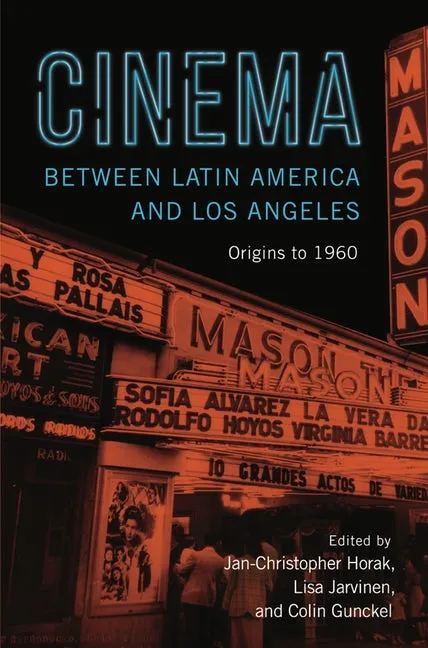
Cinema betwen Latin America and Los Angeles. Origins to 1960
Edited by Colin Gunckel, Jan-Christopher Horak, Lisa Jarvinen
Historically, Los Angeles and its exhibition market have been central to the international success of Latin American cinema. Not only was Los Angeles a site crucial for exhibition of these films, but it became the most important hub in the western hemisphere for the distribution of Spanish language films made for Latin American audiences. Cinema between Latin America and Los Angeles builds upon this foundational insight to both examine the considerable, ongoing role that Los Angeles played in the history of Spanish-language cinema and to explore the implications of this transnational dynamic for the study and analysis of Latin American cinema before 1960. The volume editors aim to flesh out the gaps between Hollywood and Latin America, American imperialism and Latin American nationalism in order to produce a more nuanced view of transnational cultural relations in the western hemisphere.
Contributions by Jacqueline Avila, Alstair Tremps, Viviana García Besné, Desirée J. Garcia, Nina Hoechtl