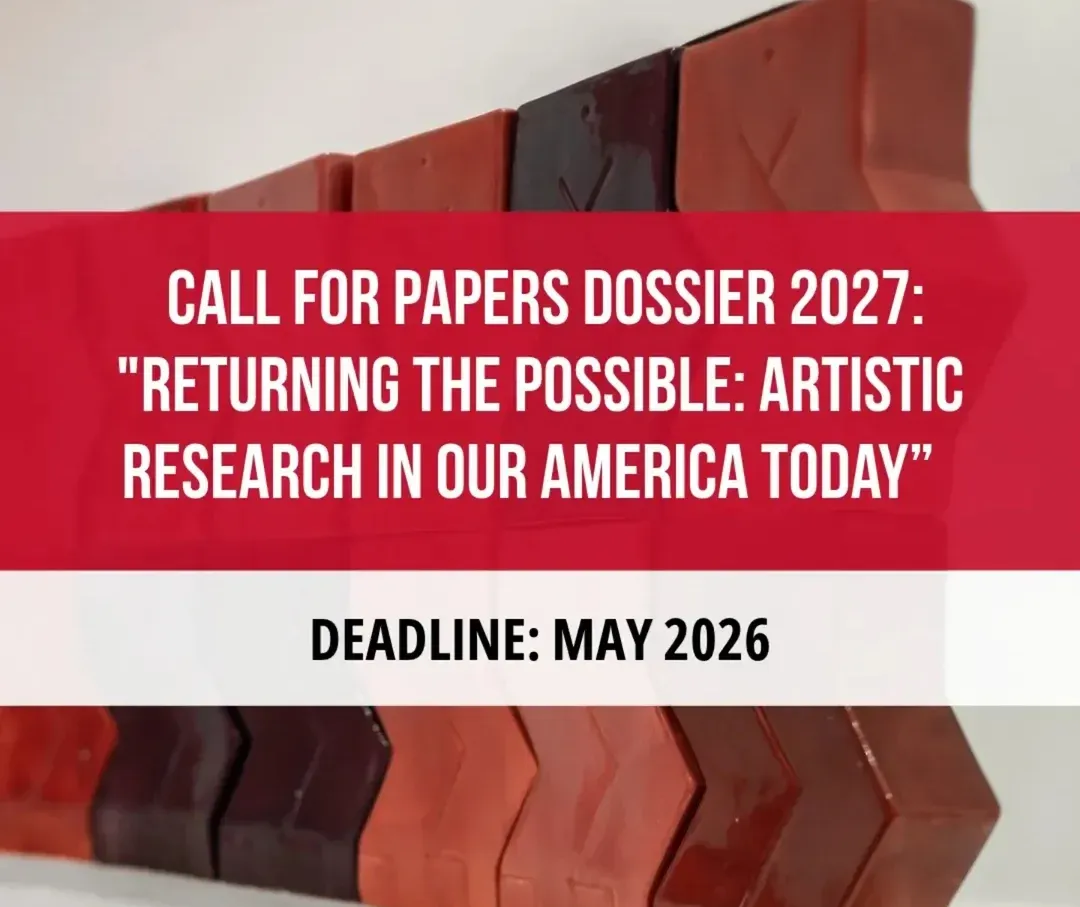
Call Dossier 2027: "Returning the Possible: Artistic Research in Our America Today"
“We live in mutant times. Not times of transition, but in a trance,” writes Luis Ignacio García (2026) about the rise of the far right in Argentina and across the region. In response to this diagnosis, García proposes giving the present back its possibility, even when it seems closed off. This dossier takes up that challenge and brings it into the field of art. It asks what artistic research can do in this scenario: the worlds it rehearses, the alliances it weaves, and the gestures it invents to inhabit a time we do not yet know how to name.
Over the past decades, artistic practices have undergone a “research turn” that has brought them into the university. This passage has been neither linear nor innocent. It has legitimized art as a way of producing knowledge, but it has also subjected art to metrics, formats, and languages that are not always its own (Steyerl, 2010). Researching from, with, and through practice means shifting the questions of what counts as knowledge, what forms it can take, who produces it, and how it is made public and shared.
This shift does not happen in an institutional or political vacuum. Universities and spaces of artistic circulation are part of broader struggles over the recognition of knowledge, bodies, memories, and ways of life, in which some are consolidated while others are pushed to the margins. From Our America, these tensions become all the more urgent in the face of rollbacks on sexual and reproductive rights and on the rights of sexual and gender dissidents, the weakening of memory policies, and a growing backlash against feminist, anti-racist, transfeminist, and cuir agendas (Butler, 2024; Rolnik, 2019). Thinking about artistic research in this context calls for attention not only to the knowledge it produces but also to the ways it intervenes in the political conflicts of the present.
How do images, archives, bodies, pedagogies, and collective practices respond to contexts of conservative backlash? What forms of resistance, care, memory, and organization can we imagine through art? How do feminist, anti-racist, transfeminist and cuir practices contest the national narratives, official memories and projects for the future that are currently at stake in the region and across the continent?
This dossier invites articles on artistic research, with particular attention to Latin American experiences and their relationship to the region’s current political moment. We are interested in how these perspectives take shape in artistic, curatorial, archival, editorial, sound, and performative practices. Possible lines of inquiry include:
- Feminist, anti-racist, transfeminist, and cuir archives and counter-archives. Strategies of selection, erasure, and reactivation.
- Historiographic revisions of art. Dictatorships and post-dictatorships through the lens of gender, sexuality, and race.
- Art and political struggles in contemporary Latin America. Practices that respond to authoritarianism, censorship, the rollback of rights, democratic crises, and state violence.
- Images that resist. Photography, film, and video beyond representation.
- Gestures of time. Anachronisms, repetitions, and memories that interrupt linear narratives.
- Editorial, sound, performative, and pedagogical practices as forms of knowledge and collective organization.
- Artistic and curatorial research as a method. Research articles on experimental writing, collaborative processes and ways of thinking with materials, bodies and communities.
Priority will be given to academic articles that address, from Our America, interdisciplinary artistic processes in their theoretical and practical dimensions. The deadline for submissions is June 30, 2027. Texts will undergo double-blind peer review, and accepted articles will be published in issue no. 46 (2027).
Submissions will be evaluated according to the journal’s guidelines: https://revistaestudav.usach.cl/es/instrucciones-para-autoras-y-autores
Dr. Cynthia Shuffer. Universidad de Santiago de Chile (USACH) cynthia.shuffer@usach.cl Dr. Debora Pazetto. Universidade do Estado de Santa Catarina (UDESC) debora.pazetto@udesc.br Dr. Nina Hoechtl. Universidad Nacional Autónoma de México (UNAM) nina.hoechtl@cieg.unam.mx
More information: revistaidea@usach.cl